
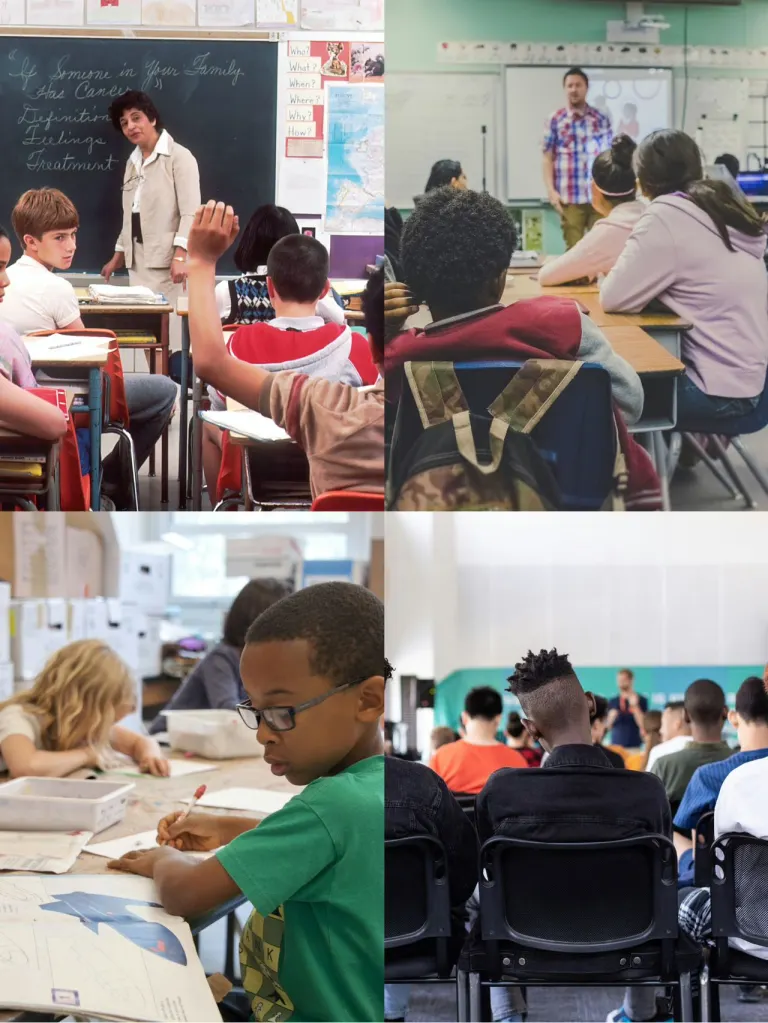
Count yourself lucky if you have access to any form of immersion program in your minority language. The real advantage is that the child hears the language from many different people and during a wide variety of activities. But the “sink or swim” aspect of full immersion worry some, as do a value system rooted in a foreign culture.
The advantage of immersion programs
By far the best way for a preschooler to excel in a foreign language is an immersion program such as a full immersion daycare or preschool which can be especially useful if neither parent speaks the minority language. Why? For better or worse, your child learns far more from other kids than from any adult. So, take advantage of this when it works in your favor!
Immersion schools are an outstanding resource, provided the overall academic level is comparable to regular schools. If immersion programs are available in your area, take the time to visit and to seriously consider them. A second-best option is to join or start a playgroup.
What to expect from full immersion
Children who have some foundation in a language can really hit the fast track when attending an immersion preschool or daycare. But even monolinguals do much better than their parents could ever hope. Most schools admit a good number of monolingual children with no prior exposure to the immersion language. The more a child without previous language exposure attends the better, but three full days per week is typically the minimum (or five half days.) It also depends upon your child’s knack for language, motivation, outgoing nature, etc. Below is what you can expect from three days per week of immersion.
First month: Everything is new, and the child will resist the change vehemently. Typically, after the initial crying bouts, he may be quieter and more reserved than his normal self at school and may resist playing with the other kids. Remember that this sort of behavior is extremely common even if there isn’t a new language involved — it is a normal toddler reaction to any large change!
Second month: The child begins to adjust to the new situation. He opens up and plays more with the other kids and begins to learn the basic words (yes, no, food items, etc.) He begins to like and gain trust in the teachers.
Third month and beyond: The child becomes comfortable with the situation and starts to enjoy himself, really accelerating his language learning. He has made a few friends and looks forward to seeing them. (Remember, happy kids learn the fastest.) At this stage, he’ll increase his vocabulary much faster and start to combine words into simple sentences, maybe even picking up some basic grammar. If you can keep up this kind of language interaction, you’re really off to the races. After about one semester, he will be comfortable using the minority language and will be quickly catching up to his peers — well on his way to speaking a foreign language, just by playing and having fun!
 Winter Overseas Education